
Buying a property in Marrakech to combine personal use and seasonal holiday letting can be attractive, but the actual return depends on three variables you must master from day one: the type of property, the Moroccan regulatory framework for short-term lets, and your ability to run operations from abroad. This guide answers the core questions a non-resident investor needs to settle before signing — what to buy, how to declare, what to expect realistically, and how to delegate without losing control.
Direct answer: To buy and let a Marrakech property seasonally from abroad, you need to match the property type (riad, serviced apartment, villa) to the demand profile, register and declare the activity under Moroccan law — including the annual revenue declaration before 1 March with the 40% rental allowance — and most often appoint a local management agency with a clear, written mandate. Advertised yields should always be reviewed net of seasonality, operating costs and tax.
Key decisions before you invest in a Marrakech holiday let
- Choose the property type based on target guests and operational constraints, not aesthetics alone.
- Confirm the legal use of the property for tourist accommodation before signing.
- Model net income after seasonality, management fees, maintenance and tax.
- Compare self-management with a local agency against your real availability.
- Run due diligence with a Moroccan notary and, ideally, an independent surveyor.
Real estate for sale in Marrakech: what property types suit seasonal letting?
The first question any investor should answer is which kind of property genuinely fits short-term rental demand in Marrakech. The city attracts a very diverse clientele — couples seeking an authentic medina experience, families looking for a private pool, and business travellers who want modern comfort near Guéliz — and each profile matches a specific type of asset. Browsing current listings of real estate for sale in Marrakech is a useful starting point to understand price brackets per neighbourhood before narrowing the search.
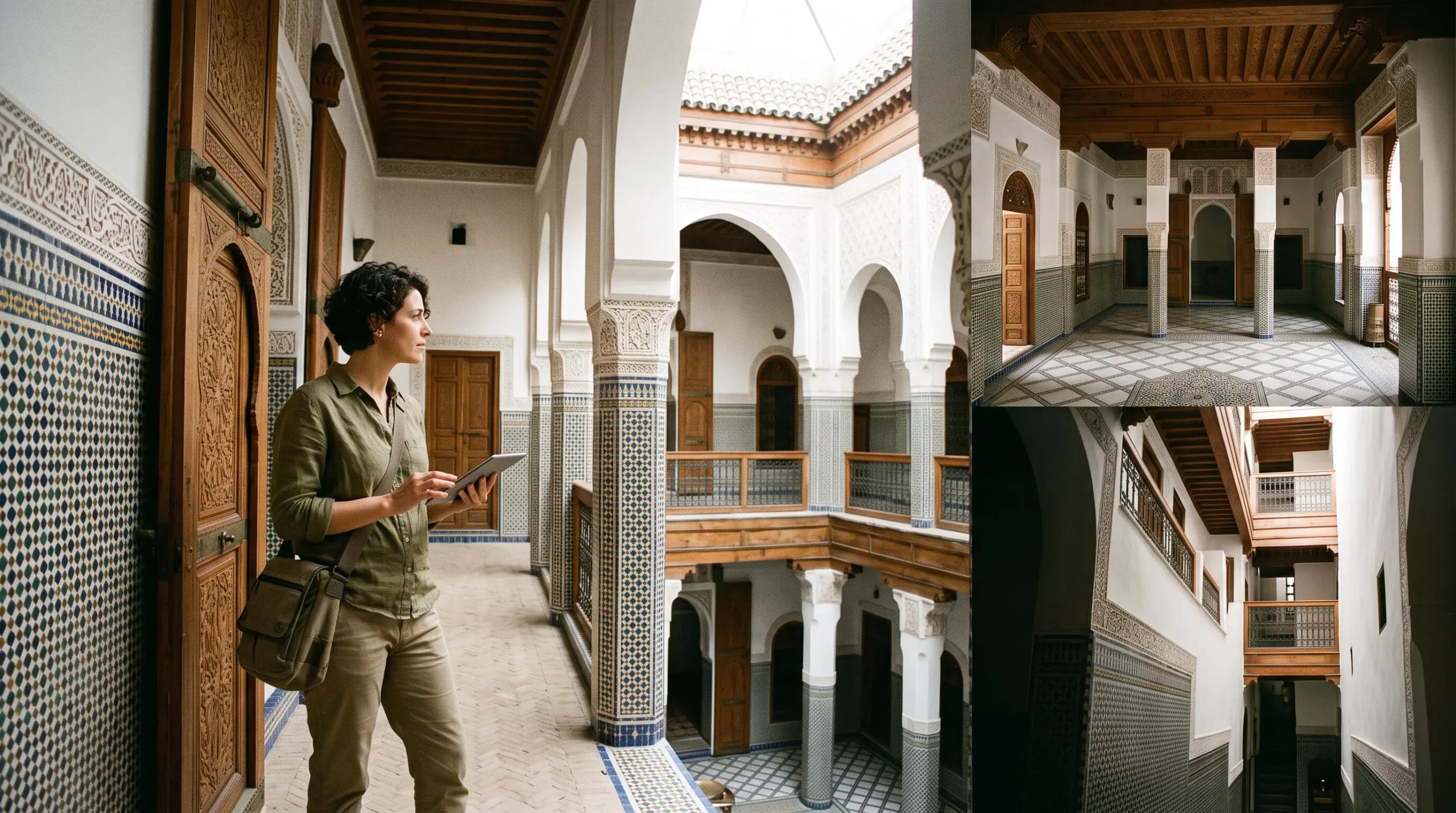
Riads, apartments or villas: matching the asset to the demand
Riads in the medina remain emblematic. Their architectural identity and central location strongly appeal to international leisure guests looking for an experience they cannot find elsewhere. The counterpart is operational: traditional construction, patios open to the elements, difficult vehicle access and ongoing restoration needs mean maintenance costs and on-site staff are rarely optional.
Apartments in serviced residences — particularly in Guéliz, Hivernage or along the Avenue Mohammed VI — are often the most straightforward option for remote owners. Shared pool, concierge, security and standardised layouts make check-ins, cleaning and small repairs much easier to delegate. The trade-off is a less distinctive guest experience and generally lower nightly rates than a well-run riad or villa.
Villas with a private pool, mainly in the Palmeraie or on the Route de l’Ourika, address a higher-end clientele, often families or groups renting for a week or more. Nightly rates can be significantly higher, but so are running costs: pool maintenance, gardening, larger cleaning teams and higher utility bills during peak summer.
| Criterion | Riad (medina) | Serviced apartment | Villa with pool |
|---|---|---|---|
| Typical guest profile | International couples, cultural tourism | Short city breaks, business travellers | Families, groups, high-end leisure |
| Ease of remote management | Low to medium | High | Medium |
| Operating costs | High (staff, maintenance) | Low to medium (service charges) | High (pool, garden, utilities) |
| Seasonality sensitivity | Medium | Lower (year-round urban demand) | High (peak in spring/autumn) |
The decision rule is pragmatic: the more distinctive the property, the more management attention it demands. A non-resident owner with limited time usually benefits from the simplest operational setup compatible with the targeted guest profile.
The regulatory framework for short-term holiday lets in Marrakech
Seasonal letting in Morocco is not an informal activity. It falls within the broader framework of tourist accommodation establishments, structured by Law n°80-14 and its implementing decree. Before marketing a property on booking platforms, an owner must understand both the licensing logic and the tax treatment of rental income.

Classification and authorisation to operate
The ministerial order setting out administrative templates for tourist establishments confirms that tourist accommodation in Morocco — including guesthouses and furnished rentals operated commercially — is subject to provisional classification and an authorisation to operate, delivered by the Ministry of Tourism. The framework stems from Law n°80-14 on tourist establishments and other forms of tourist accommodation, promulgated by dahir n°1-15-108, and from implementing decree n°2-23-441.
In practice, this means an owner intending to let a riad or villa on a regular, commercial basis to tourists should expect to lodge a classification file and obtain an operating authorisation, rather than relying purely on an online listing. Compliance obligations vary with the type of establishment and the municipality’s requirements, which is why local professional advice is essential.
Taxation of rental income for non-resident owners
Rental income earned in Morocco is taxable in Morocco, including for non-resident owners. According to the guide to the annual declaration of global income published by the Direction Générale des Impôts, owners or usufructuaries receiving rental income must file an annual declaration before 1 March, with a 40% flat allowance applied to gross rental income from built and unbuilt immovable property. The DGI guide specifies that “l’abattement de 40% est calculé au titre du revenu brut provenant de la location des immeubles bâtis et non bâtis”.
Beyond income tax, double-taxation treaties signed by Morocco often prevent the same income from being taxed twice, but the specific calculation depends on your country of residence. A Moroccan tax adviser familiar with international profiles should validate your personal setup before you project net returns.
Compliance risk to anticipate: operating a tourist rental without the required classification or without declaring rental income exposes the owner to administrative penalties and tax reassessments. Treat registration and declaration as prerequisites, not optional steps.
What rental income can a Marrakech property realistically generate?
The honest answer is that no single yield figure applies to Marrakech. Realistic income depends on four variables: nightly rate, occupancy rate, operating costs and tax. Headline yields advertised by sellers or platforms typically refer to gross figures that do not survive a careful net calculation.
Seasonality and occupancy: the demand reality
Marrakech is one of the most visited destinations in Morocco, but demand is unevenly distributed throughout the year. According to figures from the Observatoire marocain du tourisme reported on tourism performance in Marrakech in 2025, the city recorded around 5 million overnight stays in the first half of 2025, with a hotel occupancy rate of 71 % in 2025, against 68% in 2024.
What this means for a holiday let: hotel occupancy is a reference point, not a direct equivalent. Short-term rental occupancy depends on pricing strategy, visibility on platforms, review scores and the property’s location. Spring (March–May) and autumn (September–November) are generally the strongest periods, while July–August are quieter in the city due to heat.
From gross income to net return: a realistic simulation
To avoid overestimation, work through a simple four-step calculation. First, estimate an average nightly rate based on comparable properties in the same micro-location. Second, apply a conservative annual occupancy rate rather than a peak figure. Third, deduct operating costs: platform commissions, management fees, cleaning, utilities, maintenance, co-ownership charges and insurance. Fourth, apply Moroccan income tax after the 40% allowance.
Hypothetical case
Consider an apartment in Guéliz let for an average nightly rate of 1,000 MAD, with an assumed annual occupancy of 55%. Gross income reaches roughly 200,000 MAD per year. A management agency charging 20% retains 40,000 MAD; cleaning, utilities, maintenance and charges might absorb another 40,000 MAD, leaving approximately 120,000 MAD before tax. After applying the 40% rental allowance and the applicable income tax scale, the actual net return is materially lower than the headline yield a seller might quote. This illustration is indicative only — your own figures must rely on verified local comparables.
The gap between gross income and real net return is often where investors are disappointed. Any projection should be stress-tested with a lower occupancy scenario (for instance 40%) to check that the investment remains viable in a weaker year.
Managing a seasonal rental from abroad: practical steps
Running a holiday let from thousands of kilometres away is possible, but it rarely works on improvisation. The core decision is whether to self-manage with the help of local service providers or to delegate operations to a specialised agency. Each option has a cost structure, a level of control and a risk profile.

Self-management versus a local management agency
Self-management keeps nightly revenue intact but requires reliable local contacts (housekeeper, handyman, meet-and-greet) and real time investment: responding to messages, coordinating cleanings, handling emergencies and keeping calendars synchronised. It can work for owners with strong personal ties in Marrakech and limited portfolio size.
Delegating to a management agency typically costs between 15% and 25% of gross rental income, sometimes more for full-service packages including interior restyling or revenue management. The agency takes care of listings, dynamic pricing, guest communication, check-ins, cleaning and routine maintenance. The cost is real, but so is the time recovered and the risk reduction.
- Single point of contact in Marrakech.
- Faster response to guest issues and emergencies.
- Dynamic pricing expertise and multi-platform distribution.
- Coordinated maintenance and standardised cleaning.
- Commission reduces net income significantly.
- Variable service quality between providers.
- Risk of opaque reporting without a clear contract.
- Dependence on one operator for key operations.
Clauses to secure in a rental management agreement
A written mandate is non-negotiable. Before signing, verify the following elements, which are regularly the source of disputes between non-resident owners and local operators:
- Scope of services: listing creation, pricing, bookings, check-in/out, cleaning, laundry, maintenance thresholds, reporting cadence.
- Commission structure: percentage, basis of calculation (gross or net of platform fees), additional fees for specific interventions.
- Revenue remittance: frequency of transfers, bank account used, currency, exchange rate rules.
- Reporting: monthly statement with occupancy, nightly rates, expenses, invoices attached.
- Owner access: personal use periods, blocking rules on the calendar, notice period.
- Termination: notice period, handover of guest reviews and future bookings, data portability.
- Liability: insurance coverage, damage handling, security deposit management.
Buying in Marrakech: key checks before committing
The due diligence stage is where most avoidable mistakes are made. Marrakech combines a dynamic market with legal particularities — notably the coexistence of titled and untitled land — that make professional support indispensable.
- Verify the land titleConfirm that the property has a titre foncier (registered land title) and request a recent certificate from the Agence Nationale de la Conservation Foncière. Untitled property (melkia) is possible but requires significantly more legal caution.
- Check the authorised useReview co-ownership rules (règlement de copropriété) for apartments and local urban planning for riads and villas. Some buildings explicitly prohibit short-term tourist rentals.
- Assess the physical conditionCommission a surveyor’s report, especially for riads where humidity, structural movement and roof condition can hide substantial renovation costs.
- Model renovation and setup costsAdd renovation, furnishing, equipment, legal fees and classification costs to the acquisition price before computing yield.
- Instruct an independent notaryIn Morocco, the notaire (or adoul for certain traditional transactions) drafts the deed and secures the funds. Choose one familiar with foreign buyers.
- Confirm your tax setupValidate with a Moroccan tax adviser how rental income will be declared and how it interacts with your country of residence.
- If you buy a titled apartment in a serviced residence:A local real estate agent, a notary and a management agency are usually sufficient to secure the project.
- If you buy a riad in the medina:Add a surveyor specialised in traditional buildings and a lawyer to review the regulatory framework for tourist accommodation.
- If you buy a villa for high-end rentals:Involve a management specialist early, as pricing strategy and service design directly affect the viability of the business plan.
Given the number of moving parts — legal, fiscal, operational and commercial — most non-resident investors benefit from working with an experienced intermediary who coordinates these specialists. To understand the role of an advisory partner and how it can reduce execution risk, this analysis on why use a real estate consultant provides a useful framework.
Can a non-resident buy property in Marrakech freely?
Foreign buyers can acquire urban property in Morocco, including in Marrakech, with few restrictions. Agricultural land outside urban perimeters is subject to specific rules. Transactions are secured by a Moroccan notary, and funds must generally transit through a convertible dirham account to allow future repatriation of rental income or sale proceeds.
Do I need to register my seasonal rental activity?
Tourist accommodation in Morocco is governed by Law n°80-14 and its implementing decree, which organise classification and authorisation to operate. The exact administrative formalities depend on the type of property and its commercial use. A local lawyer or management agency will confirm the applicable procedure for your specific case.
How are rental income taxes paid as a non-resident?
Rental income from a Moroccan property is declared annually to the Direction Générale des Impôts before 1 March, with a 40% flat allowance on gross rental income from built and unbuilt immovable property. The remaining amount is subject to income tax under the applicable scale. A tax treaty between Morocco and your country of residence usually prevents double taxation, but the mechanism varies and should be checked with an adviser.
What occupancy rate should I assume in my business plan?
No single figure applies. Hotel occupancy in Marrakech was reported at 71% in the first half of 2025 according to the Observatoire marocain du tourisme, but short-term rentals follow their own dynamics driven by location, pricing, reviews and visibility. Build at least two scenarios — a central case and a stress case with lower occupancy — before committing capital.
Investing in Marrakech for seasonal letting is a credible project when the three fundamentals — property fit, regulatory compliance and remote management setup — are addressed before signing, not after. The city’s tourist appeal is real, but so is the gap between advertised yields and audited net returns. Treating the acquisition as a business decision, supported by a Moroccan notary, a tax adviser and a professional management partner, is what turns a speculative purchase into a sustainable rental activity.